Canned chicken is the least glamorous thing in the pantry and one of the most useful. It is cooked, it keeps for years, and it turns into lunch with a fork and a bowl. Sweet Sue packs it four ways.
The four packs are not the same product in different jackets. The fill changes, the liquid changes and the price per ounce changes several times over. A few minutes with the labels saves money and a few wrong cans.
Four ways Sweet Sue packs cooked chicken
The smallest is a 3 oz foil pouch of premium chunk white chicken. Next comes the 5 oz can of chunk white chicken in water, the size of a tuna can. The 10 oz can holds twice that. The largest is a 50 oz can of boneless chicken with broth, the kind a cafeteria opens.
| 3 oz pouch | 5 oz can | 10 oz can | 50 oz can | |
|---|---|---|---|---|
| What is inside | Premium chunk white chicken breast, sealed in a single-serving foil pouch | Chunk white chicken breast with rib meat, packed in water | Premium chunk white chicken breast with rib meat, packed in water | Boneless chicken meat packed in its own chicken broth |
| Net | 3 oz (85 g) | 5 oz (141 g) | 10 oz (284 g) | 50 oz (3 lb 2 oz) |
| Container | Foil pouch | Can with a pull-tab lid | Can with a pull-tab lid | Can |
| Ready to eat | Fully cooked, refrigerate after opening | Fully cooked, ready to eat | Fully cooked, ready to eat | Fully cooked, ready to serve |
| Price | from $3.12 | from $2.98 | from $4.44 | from $11.48 |
| Lowest price per ounce | $1.00 | 36¢ | 44¢ | 23¢ |
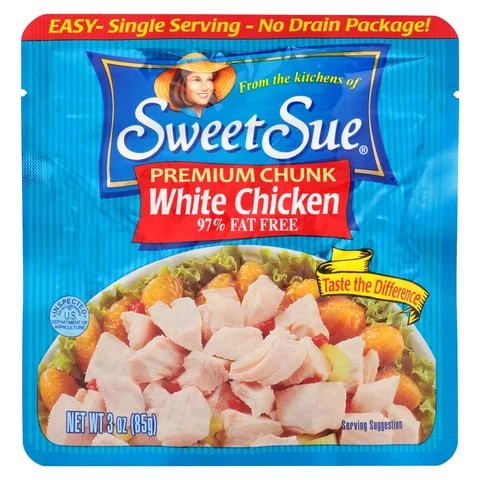 Premium Chicken Breast, 3 oz Pouchfrom $3.12 · $1.00/oz
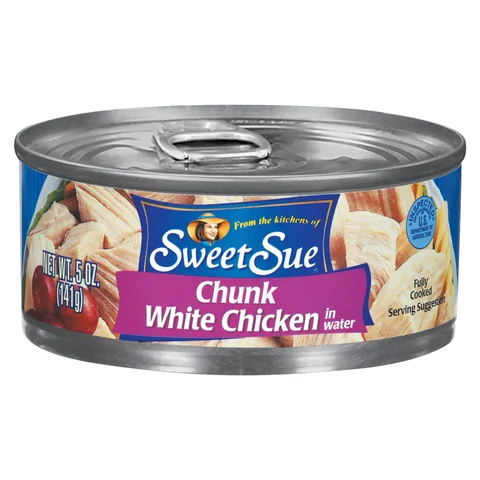 Chicken Breast in Water, 5 oz Canfrom $2.98 · 36¢/oz
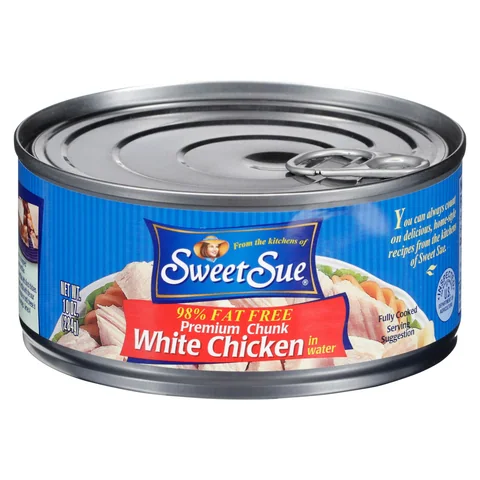 Chicken Breast in Water, 10 oz Canfrom $4.44 · 44¢/oz
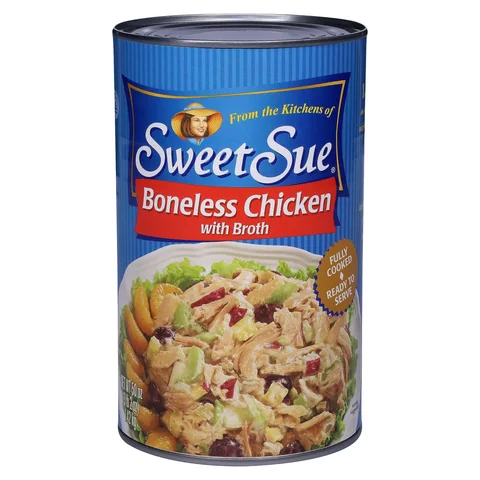 Boneless Chicken with Broth, 50 oz Canfrom $11.48 · 23¢/oz
Three of the four hold chicken breast. The cans add the words with rib meat, which is the label's own description of the cut. The bulk can says boneless chicken, with no claim that it is breast only, and its pieces come in their own broth.
What the labels say
The nutrition panels use different serving sizes, so the numbers need a careful eye. The cans count a serving as 2 ounces. The pouch counts the whole 3 oz pouch as one serving.
| Calories | 60 |
|---|---|
| Total fat | 2 g |
| Saturated fat | 0.5 g |
| Cholesterol | 10 mg |
| Sodium | 320 mg 13% DV |
| Total carbohydrate | 0 g |
| Dietary fiber | 0 g |
| Total sugars | 0 g |
| Protein | 11 g |
| Calories | 100 |
|---|---|
| Total fat | 1.5 g |
| Saturated fat | 0.5 g |
| Cholesterol | 50 mg |
| Sodium | 510 mg 22% DV |
| Total carbohydrate | 1 g |
| Dietary fiber | 0 g |
| Total sugars | 0 g |
| Protein | 20 g |
| Calories | 70 |
|---|---|
| Total fat | 3 g |
| Saturated fat | 1 g |
| Cholesterol | 30 mg |
| Sodium | 270 mg 11% DV |
| Total carbohydrate | 1 g |
| Protein | 10 g |
The serving size reflects the amount that people typically eat or drink. It is not a recommendation of how much you should eat or drink.
The ingredient lists
The canned chunk white chicken has 5 ingredients: white chicken, water, 2% or less of salt, modified food starch, sodium phosphate. The pouch lists the same five in a slightly different order, under the heading cooked chicken breast. Neither label carries a Contains line, and the product details mark both gluten free.
The 50 oz can reads differently. Its 7 ingredients are chicken meat, chicken broth, less than 2% of modified corn starch, salt, sodium phosphate, garlic powder, carrageenan. The broth, the garlic powder and the carrageenan are what set it apart from the cans packed in water.
| Pack | Serving | Servings | Calories | Protein | Fat | Sodium |
|---|---|---|---|---|---|---|
| 3 oz pouch | 1 pouch (85 g) | 1 | 100 | 20 g | 1.5 g | 510 mg |
| 5 oz can | 2 oz (56 g) | about 2 | 60 | 11 g | 2 g | 320 mg |
| 50 oz can | 2 oz (56 g) | 25 | 70 | 10 g | 3 g | 270 mg |
The 10 oz can is missing from that table for a plain reason: its nutrition panel is not pictured with the product. The product details give 60 calories and 11 g of protein a serving, the same as the 5 oz can, and the can itself carries the full panel.
Same chicken, different numbers: an ounce-for-ounce look
A pouch serving and a can serving are not the same size, which makes the panels hard to compare. Dividing each number by the ounces in the serving puts the packs on one scale. The figures below come straight from the labels.
The pouch looks salty at first glance, with 510 mg on the panel against 320 mg for the can. Most of that gap is serving size. Ounce for ounce the pouch carries 170 mg and the can 162 mg.
One buyer of the pouch was caught out by this. The buyer expected a lower sodium figure and found 510 mg on the pouch that arrived. The pouch pictured with the product today shows 510 mg, so check the panel on the label and not an old picture.
5% DV or less of sodium per serving is considered low, and 20% DV or more of sodium per serving is considered high.
By that FDA guide a 2 oz serving of the canned chicken, at 13% of the Daily Value, sits in the middle. A whole pouch, at 22%, crosses the line into high. Draining a can pours off some of the salted water, though the label does not say how much sodium leaves with it.
| Pack | Protein per ounce | Protein in one unit | Grams of protein per dollar |
|---|---|---|---|
| 3 oz pouch | 6.7 g | 20 g | 7 g, pack of 18 |
| 5 oz can | 5.6 g | about 22 g | 12 g, pack of 24 |
| 50 oz can | 5.1 g | 250 g | 22 g, single can |
Grams of protein per dollar is the figure for anyone feeding a family on a budget. It divides the protein on the label by the price of the cheapest pack. The bulk can and the multi-packs of small cans stretch a dollar furthest, and the single pouch the least.
Which size for which recipe
Recipes ask for cooked chicken by the cup. A drained 5 oz can gives roughly half a cup of flaked chicken, and a drained 10 oz can roughly a cup. Start from the dish and count back to the can.
| Dish | Cooked chicken needed | What to open |
|---|---|---|
| Chicken salad for 2 sandwiches | About half a cup | One 5 oz can |
| Lunch at a desk | One serving | One 3 oz pouch |
| Quesadillas or wraps for 4 | About 1 cup | One 10 oz can |
| A 9 by 13 inch casserole | About 2 cups | Two 10 oz cans |
| A pot of chicken noodle soup | 1 to 2 cups | One or two 10 oz cans |
| Chicken salad for 20 sandwiches | About 6 cups | One 50 oz can |
One buyer of the 5 oz can gets two large sandwiches from it as chicken salad, which matches the table. A buyer of the pouch who eats alone prefers it because a can leaves half in the refrigerator. A buyer of the 50 oz can likes that one large can covers a big dish without opening several small ones.
- 5 oz canSee the Price on Amazon
- 10 oz canSee the Price on Amazon
- 3 oz pouchSee the Price on Amazon
- 50 oz canSee the Price on Amazon
How to use canned chicken well
Canned chicken is cooked under pressure in its container. That gives it a soft, flaky texture closer to pulled chicken than to a grilled breast. It shines in dishes where it is mixed, sauced or baked, and it disappoints as a plain main course.
- 1
Drain it well
Pull the lid, press it against the chicken and tip the can over the sink. For salads, press again with a fork. Wet chicken makes a watery filling.
- 2
Flake it to suit the dish
Leave large chunks for soup and pot pie. Flake fine with a fork for chicken salad, dips and quesadillas.
- 3
Season after tasting
The chicken is already salted. Mix the dish, taste it, and only then reach for salt.
A chicken salad to start from
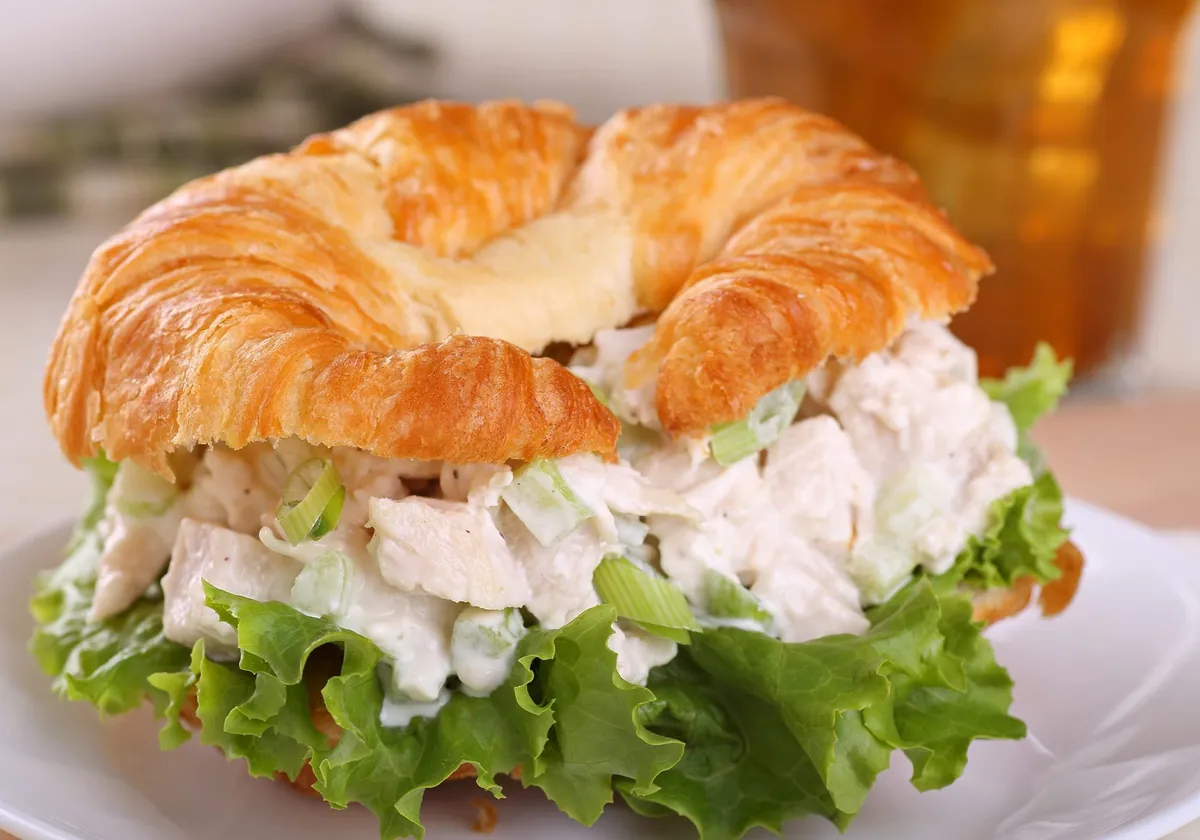
Chicken Breast in Water, 5 oz Canfrom $2.98 · 36¢/ozChicken Breast in Water, 10 oz Canfrom $4.44 · 44¢/ozPremium Chicken Breast, 3 oz Pouchfrom $3.12 · $1.00/ozBoneless Chicken with Broth, 50 oz Canfrom $11.48 · 23¢/ozFor two sandwiches, drain one 5 oz can and flake it into a bowl. Add 2 tablespoons of mayonnaise, 2 tablespoons of chopped celery, a squeeze of lemon and black pepper. Mix, taste and adjust.
From there the dish goes wherever the kitchen goes: halved grapes and pecans, curry powder and raisins, pickle relish and a boiled egg, or hot sauce and blue cheese. The base is forgiving. Remember that eggs, nuts and wheat bread each add an allergen the can itself does not have.
Hot dishes
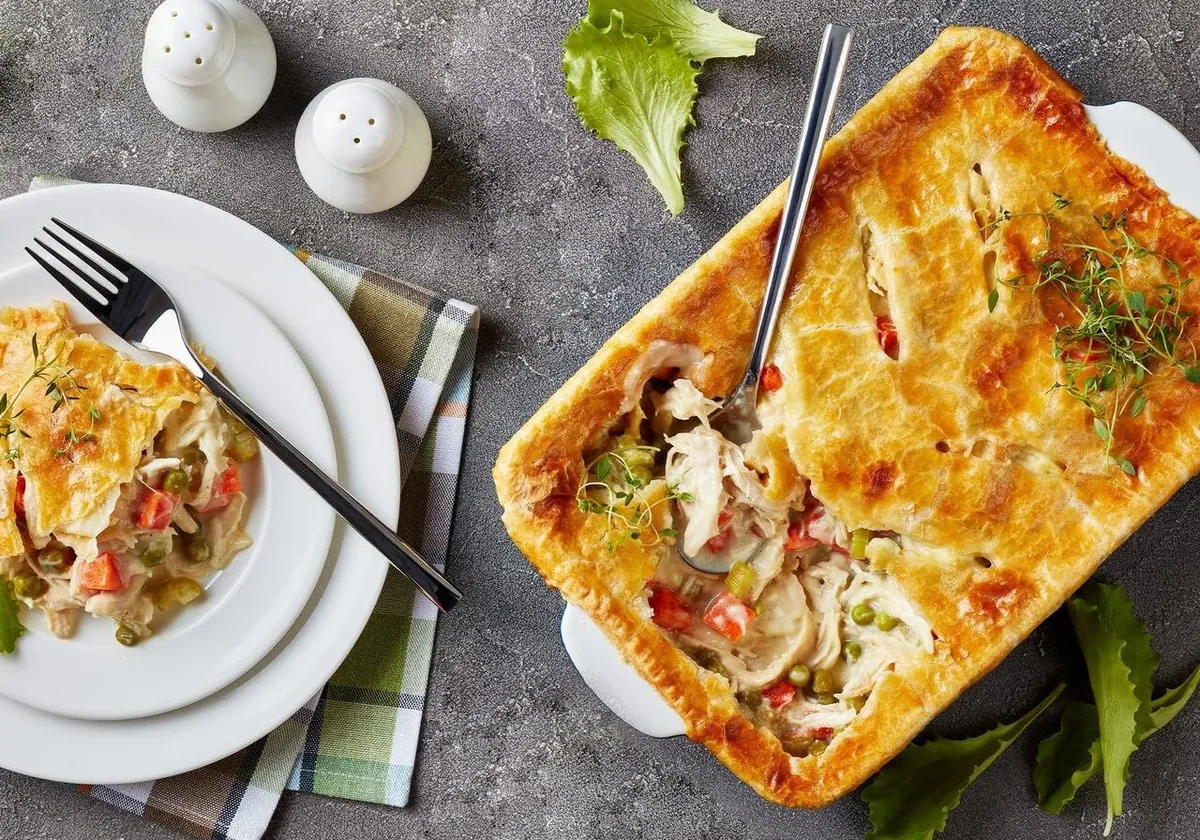
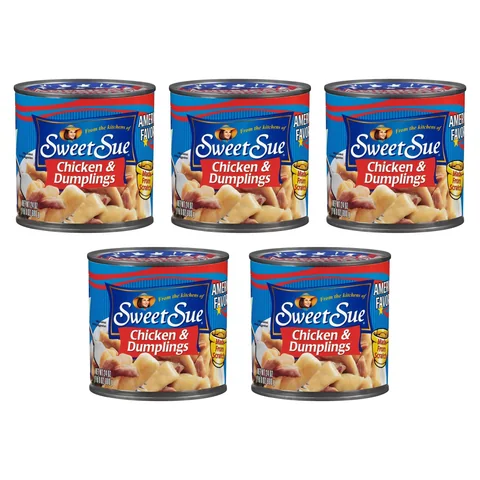
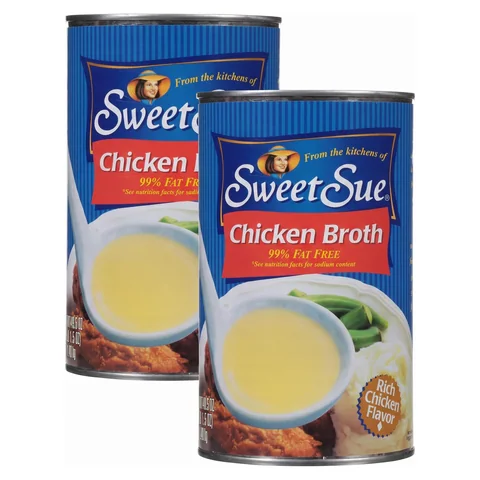
In a hot dish the chicken goes in last. It is cooked already and only needs to warm through, so stir it into soup for the final 5 minutes and fold it into a casserole just before the dish goes into the oven. A Chicken Broth, 14.5 oz Can is enough liquid for a small pot of soup with one 10 oz can of chicken. Some cooks stir a drained can into Chicken & Dumplings, 24 oz Can to make the bowl meatier.
The 50 oz can is a recipe in two parts. Lift the meat out with a slotted spoon and pull it apart for the filling. Then strain the broth and use it as the liquid for the same dish: the gravy of a pot pie, the base of a soup, the stock for a pan of dressing.
Five weeknight uses
Chicken Breast in Water, 5 oz Canfrom $2.98 · 36¢/ozChicken Breast in Water, 10 oz Canfrom $4.44 · 44¢/ozPremium Chicken Breast, 3 oz Pouchfrom $3.12 · $1.00/ozBoneless Chicken with Broth, 50 oz Canfrom $11.48 · 23¢/oz- Chicken quesadillas: one 10 oz can, drained, with 1 cup of shredded cheese between 4 tortillas.
- Buffalo chicken dip: one 10 oz can, 4 ounces of cream cheese and 3 tablespoons of hot sauce, baked until it bubbles.
- Chicken and rice: one 5 oz can stirred into 2 cups of cooked rice with a spoon of butter and frozen peas.
- Chicken noodle soup: one 10 oz can added to 4 cups of simmering broth and noodles for the last 5 minutes.
- Stuffed baked potatoes: one 5 oz can, warmed with a little broth, over 2 split potatoes.
What canned chicken does poorly
It will not brown. The meat is moist and soft, so it steams in a hot pan where fresh chicken would sear. It also falls apart when stirred hard, which rules out dishes that need neat cubes.
Chicken Breast in Water, 5 oz Canfrom $2.98 · 36¢/ozChicken Breast in Water, 10 oz Canfrom $4.44 · 44¢/ozPremium Chicken Breast, 3 oz Pouchfrom $3.12 · $1.00/ozBoneless Chicken with Broth, 50 oz Canfrom $11.48 · 23¢/ozThe flavor is mild and a little salty. A buyer of the 50 oz can was disappointed by exactly that, having hoped for the taste of a whole roasted bird. Treat canned chicken as an ingredient, give it a sauce or a dressing, and it does its job.
Canned chicken in a storm pantry
Cooked meat that needs no refrigerator and no stove is the backbone of an emergency shelf. Canned chicken and pouches fit that role well, because they can be eaten cold from the container.
The pull-tab lids of the 5 oz and 10 oz cans open without a tool, and the pouch tears by hand. The 50 oz can has a plain lid, so keep a manual can opener beside it. Small containers also make sense when the power is out: once a can is open, the leftovers need a refrigerator that may not be running.
Chicken Breast in Water, 5 oz Canfrom $2.98 · 36¢/ozChicken Breast in Water, 10 oz Canfrom $4.44 · 44¢/ozPremium Chicken Breast, 3 oz Pouchfrom $3.12 · $1.00/ozBoneless Chicken with Broth, 50 oz Canfrom $11.48 · 23¢/ozStock what the household already eats and use it in rotation. A shelf of cans bought once and forgotten is how a pantry ends up with dates from three years ago.
Pouch or can
The pouch and the 5 oz can hold nearly the same chicken. The choice between them is about where you eat and what you pay.
| 3 oz pouch | 5 oz can | |
|---|---|---|
| Opens with | A tear notch | A pull-tab lid |
| Liquid to drain | No liquid | Water |
| Servings by the label | 1 | about 2 |
| Protein in one unit | 20 g | about 22 g |
| Lowest price per ounce | $1.00 | 36¢ |
| After opening | Refrigerate, says the label | Move to a covered dish and refrigerate |
| Better choice when | You eat away from a kitchen and want no sink and no leftovers | You cook at home and want the lower price |
The pouch costs 2.8 times as much per ounce as the can at their best pack prices. What that buys is convenience: nothing to drain, nothing to wash and nothing sharp to throw away. For a desk drawer, a hiking pack or a relative who cannot manage a can, that is a fair trade.
What each pack costs per ounce
Every size comes as a single and as at least one multi-pack. The table puts all of them on one scale.
| Pack | Total net | Price | Per ounce |
|---|---|---|---|
| 3 oz pouch, single pouch | 3 oz | $3.12 | $1.04 |
| 3 oz pouch, pack of 3 | 9 oz | $9.36 | $1.04 |
| 3 oz pouch, pack of 18 | 54 oz | $53.78 | $1.00 |
| 5 oz can, single can | 5 oz | $2.98 | 60¢ |
| 5 oz can, pack of 5 | 25 oz | $14.90 | 60¢ |
| 5 oz can, pack of 24 | 120 oz | $42.67 | 36¢ |
| 10 oz can, single can | 10 oz | $4.44 | 44¢ |
| 10 oz can, pack of 5 | 50 oz | $22.20 | 44¢ |
| 10 oz can, pack of 12 | 120 oz | $53.33 | 44¢ |
| 50 oz can, single can | 50 oz | $11.48 | 23¢ |
| 50 oz can, pack of 2 | 100 oz | $22.96 | 23¢ |
The spread is wide. The lowest price per ounce is 23¢ for the 50 oz can, single can. The highest is $1.04 for the 3 oz pouch, single pouch. A bigger pack is not always cheaper per ounce, so compare the price per ounce and not the pack price.
What buyers say
The canned chunk white chicken is the most-rated Sweet Sue product: 4.6 out of 5 from 3,958 ratings across the 5 oz and 10 oz cans. Buyers praise the all-white meat, the size of the chunks and the easy lid. They use it for chicken salad, soup, casseroles and food prep in bulk.
The pouch holds 4.5 from 226 ratings. Buyers like the single serving and the lack of liquid, and several call it expensive. The 50 oz can is the divisive one at 4.1 from 226 ratings. Some call it better than they expected for the price. Others say it looks like tuna and would not buy it again.
Great chicken in individual packages
Great for anyone who can’t receive canned goods. The chicken is great quality and I’ve purchased it several times for a family member who needs this type of packaging. He loves it!
Sweet Sue canned boneless whole chicken
Sweet Sue whole canned boneless chicken comes in handy when you want to fix a good meal quick for the family. Try it!
Great purchase
I must say I was skeptical at first but once I tried them was definitely worth the purchase
Expensive but good
I mix these in instant mash potatoes and they are very good.Great source of protein.
Quality real white chicken meat at a competitive price
What do you say about canned chicken? It was exactly as I expected.It was real white chicken meat. Not a paste. Cooked well with some fat still in the can for use in recipe cooking if wanted. The size makes it great for larger dishes without needing to open multiple cans and the price per ounce is competitive.
Tasty good Chicken for salads or creamed Chicken
It was very good . Just the right amount for one person living alone
Storing canned chicken, sealed and opened
Sealed cans and pouches are shelf-stable. They belong in a pantry or a cupboard, not above the stove and not in a car trunk in July.
The ideal location is a cool, dry, dark place. The best temperature is 40°F (4°C) to 70°F (21°C).
The date on the can end speaks to quality. Canned meat is a low-acid food, the kind USDA says keeps longest.
Whereas low-acid canned foods (e.g., meats and vegetables) will keep for two to five years.
Follow proper handling of canned foods and discard cans that are dented, rusted or swollen.
Once a can is open the clock starts. Move unused chicken to a covered container, because an open can is not a storage dish. The pouch label says to refrigerate after opening, and the same goes for the cans.
Leftovers can be kept in the refrigerator for 3 to 4 days or frozen for 3 to 4 months.
Reading the can end
The lid and the base of a can carry more than a date. A stamped string of letters and numbers identifies the plant, the day and the line that filled it. Shoppers often take that code for an expiration date.
The codes are not meant for the consumer to interpret as a "Best if Used By" date.
The code matters on two occasions. A recall notice names products by it, and a complaint to the company goes faster when you can read it out. Keep the can until the food is eaten for that reason, and write the purchase month on the lid if the stamp is hard to read.
Look at the can itself as well. The seams at the top and bottom should be flat and clean, and the sides should not bulge. A pull-tab lid should sit flush. If a can hisses loudly, spurts or smells wrong when opened, do not taste the food.
Working canned chicken into what you already cook
The easiest way to use canned chicken is to stop treating it as a special ingredient. It can stand in wherever a recipe says cooked, shredded or leftover chicken. Tacos, fried rice, pasta bakes and pot pies all take it without a change to the method.
Chicken Breast in Water, 5 oz Canfrom $2.98 · 36¢/ozChicken Breast in Water, 10 oz Canfrom $4.44 · 44¢/ozPremium Chicken Breast, 3 oz Pouchfrom $3.12 · $1.00/ozBoneless Chicken with Broth, 50 oz Canfrom $11.48 · 23¢/ozTwo habits help. Add it late, so it warms without breaking down. And balance it with something fresh or crisp: celery in a salad, cabbage in a taco, a squeeze of lemon over the plate. The chicken brings the protein and the salt, and the rest of the dish brings the texture.
Questions about Sweet Sue canned chicken
Can you eat Sweet Sue canned chicken straight from the can?
Yes. The label reads fully cooked, so the chicken is safe to eat without heating. A 2 oz serving has 11 g of protein.
How many cups of chicken are in a 10 oz can?
A drained 10 oz can gives roughly 1 cup of flaked chicken. A casserole that asks for 2 cups takes two cans.
Is the Sweet Sue chicken pouch the same as the can?
Nearly. Both hold chunk white chicken breast with the same 5 ingredients. The pouch has no water to drain and costs more per ounce: $1.00 against 36¢.
- The lineSweet Sue Canned Chicken
- LabelsSweet Sue nutrition and ingredients
- Kitchen notesChicken & Dumplings, can by can
- Kitchen notesBroth and the pantry shelf
Sources
- U.S. Food and Drug Administration, How to Understand and Use the Nutrition Facts Label, read 9 October 2026
- U.S. Food and Drug Administration, Sodium in Your Diet, read 9 October 2026
- FoodSafety.gov, Food Safety in a Disaster or Emergency, read 9 October 2026
- USDA Food Safety and Inspection Service, Food Product Dating, read 9 October 2026
- USDA Food Safety and Inspection Service, Leftovers and Food Safety, read 9 October 2026
Label facts were read from the cans and pouch pictured with each product. This note is general information and not dietary advice.